

Generate random walks of various types with tidyverse compatibility
To view the full wiki, click here: Full RandomWalker Wiki
RandomWalker is a comprehensive R package that makes it easy to generate, visualize, and analyze random walks. Whether you’re modeling stock prices, simulating particle movements, or exploring stochastic processes, RandomWalker provides a unified, tidyverse-compatible interface with extensive distribution support.
Install the stable version from CRAN:
install.packages("RandomWalker")Or get the development version from GitHub for the latest features and bug fixes:
# install.packages("devtools")
devtools::install_github("spsanderson/RandomWalker")The rw30() function provides a quick way to generate 30
random walks with 100 steps each:
library(RandomWalker)

# Generate random walks
walks <- rw30()
head(walks, 10)
#> # A tibble: 10 × 3
#>    walk_number step_number      y
#>    <fct>             <int>  <dbl>
#>  1 1                     1  0
#>  2 1                     2  0.952
#>  3 1                     3  0.573
#>  4 1                     4  0.292
#>  5 1                     5  1.06
#>  6 1                     6  1.39
#>  7 1                     7  0.727
#>  8 1                     8  0.186
#>  9 1                     9 -0.305
#> 10 1 10 -0.310Create beautiful visualizations with a single function call:
rw30() |>
  visualize_walks()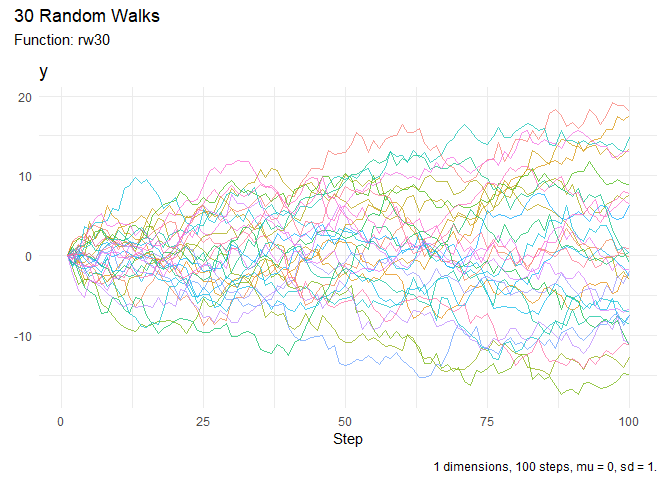
Get comprehensive statistical summaries of your random walks:
# Overall summary
rw30() |>
  summarize_walks(.value = y)
#> # A tibble: 1 × 16
#>   fns   fns_name dimensions mean_val median range quantile_lo quantile_hi
#>   <chr> <chr>         <dbl>    <dbl>  <dbl> <dbl>       <dbl>       <dbl>
#> 1 rw30  Rw30              1  -0.0134  0.302  43.1       -16.9        11.5
#> # ℹ 8 more variables: variance <dbl>, sd <dbl>, min_val <dbl>, max_val <dbl>,
#> #   harmonic_mean <dbl>, geometric_mean <dbl>, skewness <dbl>, kurtosis <dbl>

# Summary by walk
rw30() |>
  summarize_walks(.value = y, .group_var = walk_number) |>
  head(10)
#> # A tibble: 10 × 17
#>    walk_number fns   fns_name dimensions mean_val median range quantile_lo
#>    <fct>       <chr> <chr>         <dbl>    <dbl>  <dbl> <dbl>       <dbl>
#>  1 1           rw30  Rw30              1   0.834   0.911 11.3       -4.14
#>  2 2           rw30  Rw30              1  -1.63   -1.22   9.43      -5.97
#>  3 3           rw30  Rw30              1   7.51    7.34  14.3        0.579
#>  4 4           rw30  Rw30              1  10.8    11.7   18.4       -0.147
#>  5 5           rw30  Rw30              1  -3.51   -3.96  12.8       -8.49
#>  6 6           rw30  Rw30              1   6.98    8.40  21.8       -1.90
#>  7 7           rw30  Rw30              1   0.392   0.458 11.1       -4.98
#>  8 8           rw30  Rw30              1  -0.0693 -0.495  9.60      -3.34
#>  9 9           rw30  Rw30              1   7.54    7.56  11.7        1.55
#> 10 10          rw30  Rw30              1  -9.22   -8.86  19.6      -18.5
#> # ℹ 9 more variables: quantile_hi <dbl>, variance <dbl>, sd <dbl>,
#> #   min_val <dbl>, max_val <dbl>, harmonic_mean <dbl>, geometric_mean <dbl>,
#> # skewness <dbl>, kurtosis <dbl>Simulate continuous-time pendulum motion from randomized starting
angles. The solver (deSolve) and animation packages
(gganimate, gifski) are optional.
set.seed(287)
pendulum <- double_pendulum_walk(.num_walks = 2, .n = 101)
plot_double_pendulum(pendulum, .walk = 1)
animation <- animate_double_pendulum(pendulum, .walk = 1)
# Render explicitly with gganimate::animate(); construction saves no files.
See
vignette("double-pendulum", package = "RandomWalker") for
units, deterministic starts, and GIF rendering.
# Normal walk with custom parameters
random_normal_walk(
  .num_walks = 5,
  .n = 50,
  .mu = 0,
  .sd = 0.1,
  .initial_value = 100
) |>
  visualize_walks()
# Geometric Brownian Motion (great for stock prices!)
geometric_brownian_motion(
  .num_walks = 10,
  .n = 100,
  .mu = 0.05,
  .sigma = 0.2,
  .initial_value = 100
) |>
  visualize_walks()
# 2D random walk
random_normal_walk(.num_walks = 3, .n = 100, .dimensions = 2) |>
  head(10)
#> # A tibble: 10 × 14
#>    walk_number step_number       x       y cum_sum_x cum_prod_x cum_min_x
#>    <fct>             <int>   <dbl>   <dbl>     <dbl>      <dbl>     <dbl>
#>  1 1                     1 -0.0474 -0.117    -0.0474          0   -0.0474
#>  2 1                     2  0.0274 -0.0564   -0.0201          0   -0.0474
#>  3 1                     3  0.142   0.0586    0.122           0   -0.0474
#>  4 1                     4 -0.103   0.276     0.0189          0   -0.103
#>  5 1                     5  0.0206 -0.134     0.0395          0   -0.103
#>  6 1                     6 -0.131   0.0759   -0.0919          0   -0.131
#>  7 1                     7 -0.120   0.0155   -0.211           0   -0.131
#>  8 1                     8 -0.0595  0.0214   -0.271           0   -0.131
#>  9 1                     9  0.159   0.0155   -0.112           0   -0.131
#> 10 1                    10 -0.233   0.178    -0.345           0   -0.233
#> # ℹ 7 more variables: cum_max_x <dbl>, cum_mean_x <dbl>, cum_sum_y <dbl>,
#> #   cum_prod_y <dbl>, cum_min_y <dbl>, cum_max_y <dbl>, cum_mean_y <dbl>

# 3D random walk
random_normal_walk(.num_walks = 2, .n = 50, .dimensions = 3) |>
  head(10)
#> # A tibble: 10 × 20
#>    walk_number step_number        x        y        z cum_sum_x cum_prod_x
#>    <fct>             <int>    <dbl>    <dbl>    <dbl>     <dbl>      <dbl>
#>  1 1                     1 -0.0119  -0.0963   0.154     -0.0119          0
#>  2 1                     2  0.0345  -0.103   -0.278      0.0225          0
#>  3 1                     3  0.139   -0.0586  -0.0603     0.162           0
#>  4 1                     4 -0.0636  -0.0963   0.00208    0.0983          0
#>  5 1                     5 -0.174   -0.170    0.0608    -0.0755          0
#>  6 1                     6  0.124   -0.0995   0.112      0.0480          0
#>  7 1                     7 -0.111    0.00989 -0.0555    -0.0633          0
#>  8 1                     8 -0.0505  -0.159    0.00208   -0.114           0
#>  9 1                     9  0.0366  -0.0686   0.00471   -0.0772          0
#> 10 1                    10  0.00216 -0.131   -0.0555    -0.0750          0
#> # ℹ 13 more variables: cum_min_x <dbl>, cum_max_x <dbl>, cum_mean_x <dbl>,
#> #   cum_sum_y <dbl>, cum_prod_y <dbl>, cum_min_y <dbl>, cum_max_y <dbl>,
#> #   cum_mean_y <dbl>, cum_sum_z <dbl>, cum_prod_z <dbl>, cum_min_z <dbl>,
#> # cum_max_z <dbl>, cum_mean_z <dbl># Discrete walk with upper/lower bounds
discrete_walk(
.num_walks = 5,
.n = 100,
.upper_bound = 1,
.lower_bound = -1,
.upper_probability = 0.55,
.initial_value = 0
) |>
visualize_walks()
RandomWalker supports a wide variety of random walk types:
random_normal_walk(),
random_normal_drift_walk()brownian_motion(),
geometric_brownian_motion()random_beta_walk()random_cauchy_walk()random_chisquared_walk()random_exponential_walk()random_f_walk()random_gamma_walk()random_lognormal_walk()random_logistic_walk()random_t_walk()random_uniform_walk()random_weibull_walk()random_binomial_walk()discrete_walk()random_geometric_walk()random_hypergeometric_walk()random_multinomial_walk()random_negbinomial_walk()random_poisson_walk()custom_walk(),
random_displacement_walk()| Function | Description |
|---|---|
rw30() |
Quickly generate 30 random walks |
visualize_walks() |
Create visualizations (static or interactive) |
summarize_walks() |
Generate comprehensive statistics |
subset_walks() |
Subset walks by max/min values |
euclidean_distance() |
Calculate distances in multi-dimensional walks |
confidence_interval() |
Compute confidence intervals |
running_quantile() |
Calculate running quantiles |
vignette("getting-started")Contributions are welcome! Please feel free to submit a Pull Request. For major changes, please open an issue first to discuss what you would like to change.
This package is licensed under the MIT License. See LICENSE.md for details.
randomwalker tagIf you use RandomWalker in your research, please cite:
citation("RandomWalker")Made with ❤️ for the R community